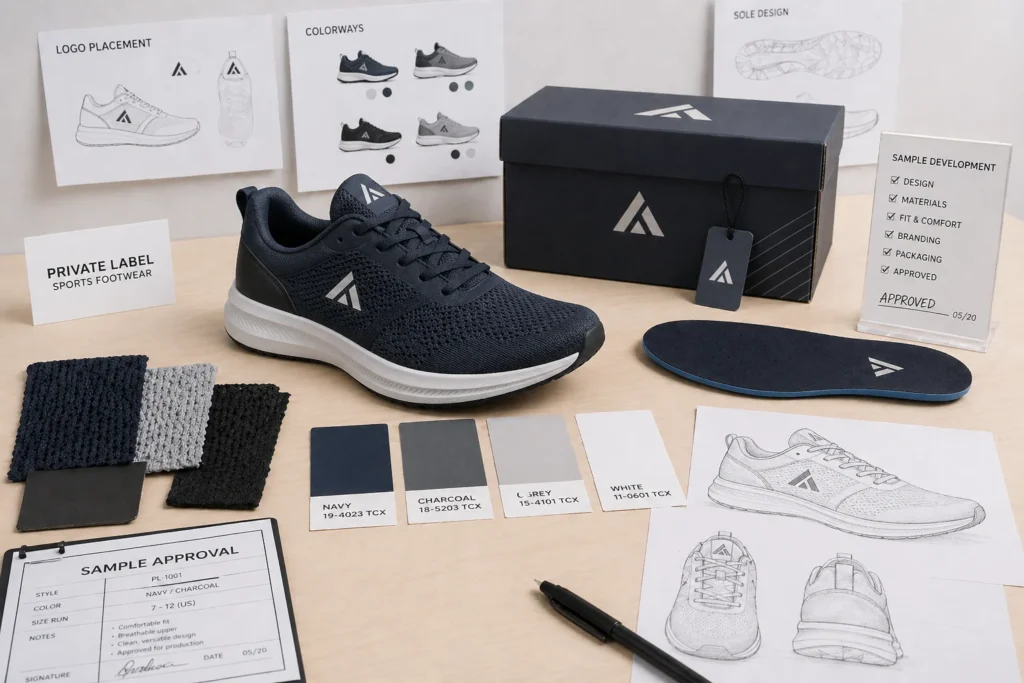
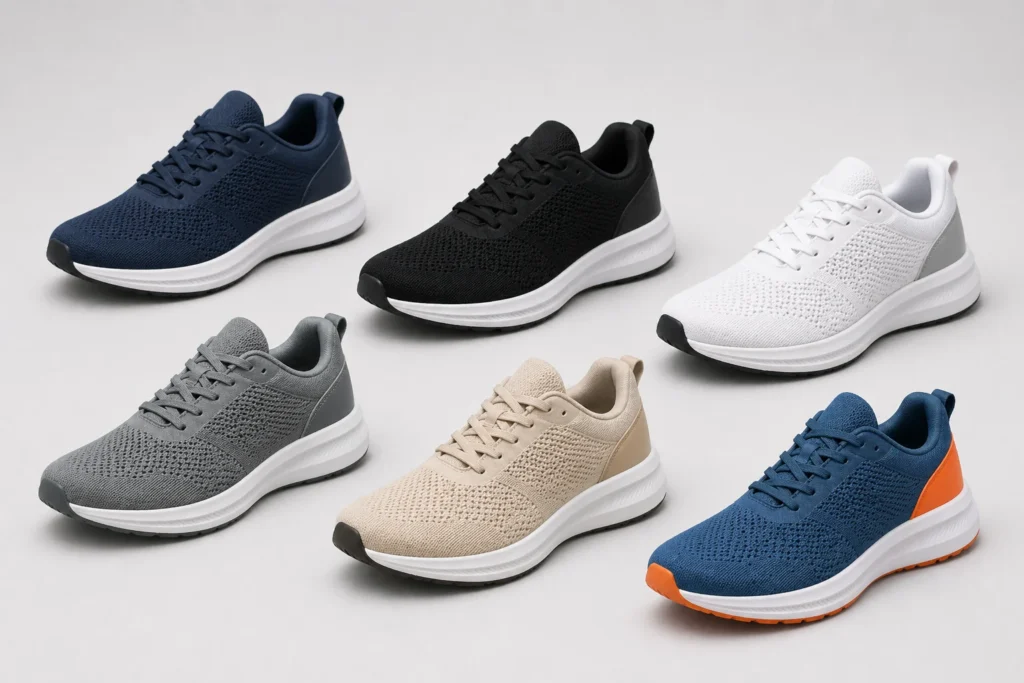
Private label sports shoes are a practical way for new footwear brands, online sellers, distributors, and retail companies to launch branded products without owning a factory. Instead of building a full production facility, buyers work with an experienced manufacturer to produce sports shoes under their own brand name.
This model allows buyers to focus on brand positioning, sales channels, marketing, and customer feedback while the factory supports product development, sample making, production, quality control, and packing. For many new brands, private label footwear is a lower-risk way to enter the market before investing in fully custom OEM development.
What Are Private Label Sports Shoes?
Private label sports shoes are products manufactured by a factory and sold under the buyer’s brand. The buyer may choose an existing shoe model, customize the logo, select colors, adjust materials, and create branded packaging.
Private label is different from simply buying blank shoes. A private label project usually includes brand identity elements such as logo placement, custom shoebox, hangtags, insole branding, carton marks, or product labels. It gives the buyer a more professional product presentation for retail, e-commerce, or wholesale channels.
Who Should Consider Private Label Footwear?
Private label sports shoes can be suitable for different types of buyers. It is especially useful when a buyer wants to build a brand but does not yet have a complete design team or production system.
- New footwear brands that want to test the market with branded products.
- E-commerce sellers looking for differentiated products instead of generic inventory.
- Distributors who want exclusive branding for their local market.
- Fitness brands or sports clubs that want branded footwear merchandise.
- Retail chains that want a private label product line.
- Wholesalers who want to improve margins with their own brand identity.
What Can Be Customized?
The level of customization depends on the manufacturer, shoe model, material availability, MOQ, and project budget. Common private label customization options include:
| Customization Area | Examples |
| Logo | Tongue label, side logo, heel logo, insole logo, outsole logo, shoebox logo. |
| Colors | Upper color, sole color, lace color, lining color, logo color, outsole color. |
| Materials | Breathable mesh, knitted upper, synthetic leather, microfiber, EVA midsole, rubber outsole. |
| Packaging | Custom shoebox, hangtag, tissue paper, size label, barcode sticker, carton mark. |
| Product Details | Laces, pull tabs, eyelets, decorative panels, insole print, outsole texture. |
| Size Range | Men’s, women’s, unisex, kids, or market-specific size ranges. |
Private Label Sports Shoes Development Process
A clear development process helps buyers reduce mistakes and launch products more smoothly. The process may vary depending on the product category and customization level, but most private label footwear projects follow these steps.
Step 1: Select a Suitable Shoe Model
The buyer chooses a base model according to target customers, sales channel, price range, and product category. Examples include running shoes, training shoes, casual sneakers, barefoot shoes, kids shoes, or hiking shoes.
Step 2: Confirm Materials and Colors
The buyer and factory confirm upper materials, midsole materials, outsole structure, color combinations, lining, laces, and other visible details. Material selection affects comfort, durability, price, and delivery time.
Step 3: Add Brand Logo and Packaging
The logo can be applied in different positions using printing, embroidery, heat transfer, woven labels, rubber patches, or insole printing. Packaging can also be customized to create a more complete brand presentation.
Step 4: Make and Review Samples
The factory prepares samples based on the confirmed requirements. The buyer reviews the sample for appearance, fit, logo effect, workmanship, color accuracy, and packaging details. If needed, adjustments are made before mass production.
Step 5: Confirm Order Details
Before bulk production, both sides should confirm price, quantity, size breakdown, packaging method, carton marks, production timeline, payment terms, and shipping requirements. Clear confirmation reduces production risks.
Step 6: Mass Production and Quality Inspection
After sample approval and order confirmation, the factory begins mass production. Quality inspection should cover materials, stitching, logo placement, sole bonding, size matching, appearance, packing, and final order quantity.
Step 7: Packing and Shipment
Finished shoes are packed according to the buyer’s requirements. Export cartons should be marked clearly to support warehouse receiving and shipping management.
Private Label vs OEM: What Is the Difference?
| Factor | Private Label Sports Shoes | OEM Sports Shoes |
| Design Base | Usually starts from an existing model or factory-developed design. | Usually based on the buyer’s own design or technical requirements. |
| Customization | Logo, colors, materials, packaging, and small product adjustments. | More control over shape, structure, outsole, materials, and design details. |
| Development Time | Usually faster. | Usually longer due to sample development and design confirmation. |
| Cost | Lower initial development cost. | Higher development investment depending on complexity. |
| Best For | New brands, wholesalers, distributors, e-commerce sellers. | Established brands or buyers with unique product designs. |
How to Choose a Private Label Sports Shoes Manufacturer
A good private label manufacturer should provide more than production. The factory should help buyers choose suitable models, explain customization options, prepare samples, control quality, and support export packing.
- Check whether the factory has experience with private label footwear.
- Ask what logo and packaging customization options are available.
- Confirm MOQ for each model, colorway, and packaging option.
- Review samples before approving mass production.
- Ask about inspection steps and how defects are handled.
- Confirm lead time for samples and bulk orders.
- Choose a supplier that communicates clearly and confirms details in writing.
Common Mistakes to Avoid
- Choosing a model only because it is cheap, without considering market positioning.
- Ignoring comfort, fit, and material quality during sample review.
- Using too many customized elements in the first order and increasing cost or lead time unnecessarily.
- Not confirming logo size, color, and placement clearly before sample making.
- Failing to plan packaging, barcode labels, carton marks, and shipping requirements early.
Frequently Asked Questions
Q1: Can I put my own logo on sports shoes?
Yes. Private label sports shoes can usually include your logo on the tongue, side panel, heel, insole, outsole, shoebox, hangtag, or carton label.
Q2: Do I need my own shoe design to start?
Not necessarily. Many private label projects start from existing ODM models. You can customize branding, colors, materials, and packaging before developing fully custom OEM products later.
Q3: What should I prepare before contacting a manufacturer?
Prepare your target product category, logo file, preferred colors, size range, target price, expected order quantity, packaging requirements, and target market.
Q4: Is private label suitable for small brands?
Yes. Private label can be a practical option for small brands because it allows them to launch branded products with lower development complexity compared with fully custom OEM production.
Conclusion
Private label sports shoes provide a practical path for new footwear brands, e-commerce sellers, distributors, and wholesalers to enter the market with branded products. By choosing a suitable model, confirming materials and colors, adding logo customization, reviewing samples, and working with a reliable factory, buyers can reduce development risk and build a more professional product line.
If you are planning to launch private label sports shoes, contact us with your brand idea, target market, logo requirements, and preferred shoe category. We can help you discuss model selection, sample development, customization options, and bulk production.